
(6 NOVEMBER – 4 DECEMBER 2025)
Open Studio
Friday 28 November 2025
On 28 November 2025, the Château de La Napoule hosted the Open Studio for its Canadian Fall Residency, bringing together ten invited artists in residence from 6 November to 4 December 2025, in partnership with the David R. Graham Foundation (DRG Foundation).
Conceived as a key moment of sharing, this public opening offered visitors the opportunity to meet the residents in their workspaces, at the Château and at Villa Marguerite, and to discover works in progress: visual artworks, texts, readings, installations, and experiments around material, narrative, and light.
At the heart of La Napoule Art Foundation’s mission, offering time, space, and a stimulating environment for creation and intercultural dialogue, this evening highlighted the diversity of practices as well as the coherence of shared concerns: the memory of places, the reappropriation of symbols, movement between disciplines, and a refined attention to surfaces, gestures, and traces.
Haley Alakan White: Craft, Transmission, and Modernity
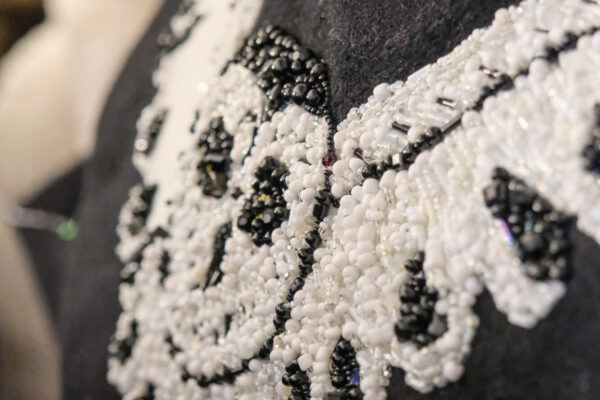
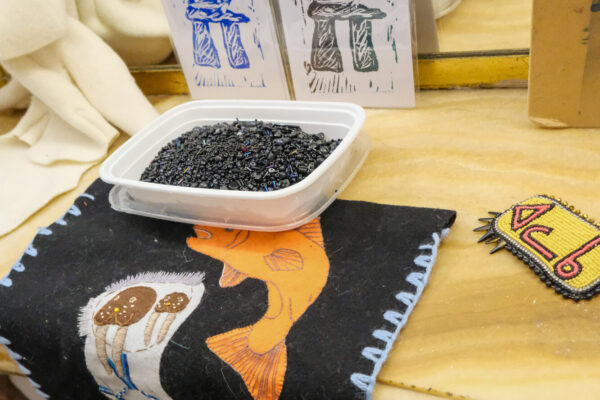
At Villa Marguerite, Haley Alakan White, an Inuk artist from Rankin Inlet (Nunavut), opened the evening by presenting a body of work created during the residency. Sewing projects, patterns, and textile pieces conversed with materials she had brought from home, animal resources such as hair, teeth, or horns, rooting her practice in direct continuity with knowledge tied to hunting and a respectful relationship to living beings, while offering a decidedly contemporary perspective on forms, uses, and contexts of presentation.
Her exchange with the public highlighted the cultural and emotional importance of clothing, understood at once as protection, an assertion of identity, and a means of transmission. One women’s garment in particular drew attention: conceived both as ceremonial attire and as a garment designed to carry a child on the back, it evokes traditional practices in which infants are carried in this way until around one year of age, recalling customs in which the child remains close to the body, in a gesture of care and continuity.
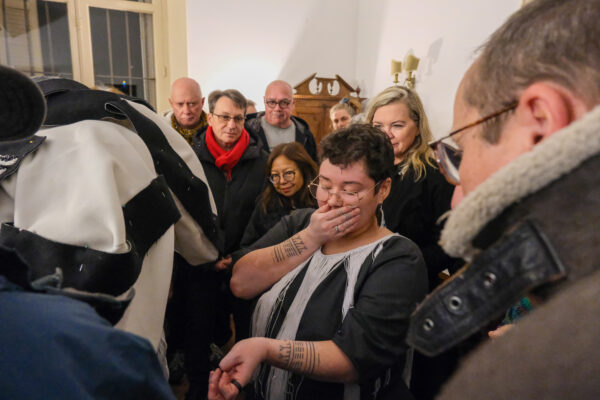 Haley Alakan White's studio in Villa Marguerite | Photo credit: Laurent Barnavon
Myfanwy MacLeod: Between Humor, Memory, and Popular Culture
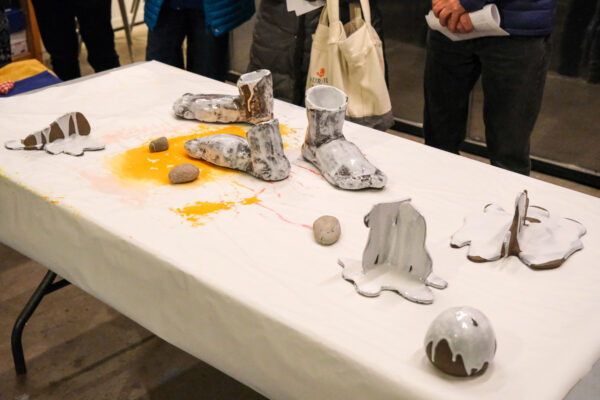
Alongside the Canadian Fall Residency, Canadian artist Myfanwy MacLeod (Vancouver) has been hosted at the Château since September as part of the Master Residency 2025, supported by the DRG Foundation. For the Open Studio, she exceptionally opened her studio and presented the first stages of Trophies, a new body of work in preparation for her exhibition at the Burnaby Art Gallery (June 2026).
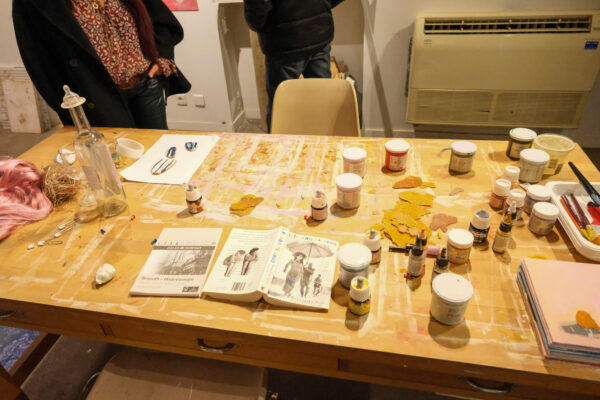
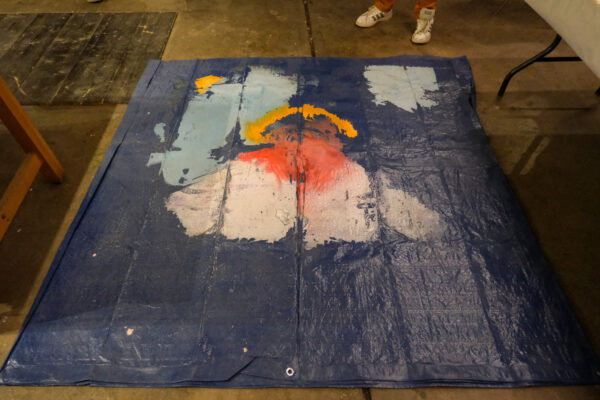
In the Noele Clews Studio, visitors discovered a group of ceramics, collages on mounted board, and painterly explorations playing with layered surfaces (perforated burlap, the grid of gingham tablecloth fabric, marks evoking pizza stains). These accidental traces, central to her process, claim the influence of Color Field Painting, and in particular the work of Helen Frankenthaler, within an approach in which matter, gravity, and the unforeseen fully participate in the composition. The ensemble reveals a practice shaped by an acknowledged tension between satire and contemplation, where humor becomes a critical tool for questioning contemporary cultural mythologies.
 Myfanwy MacLeod's studio | Photo credit: Laurent Barnavon
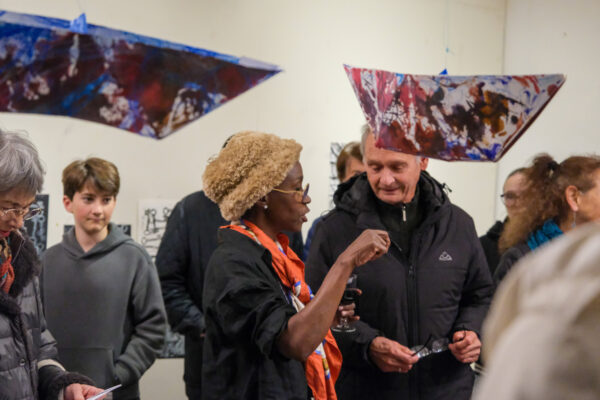
Sharon Norwood: Symbols, Power, and Gestures of Repair
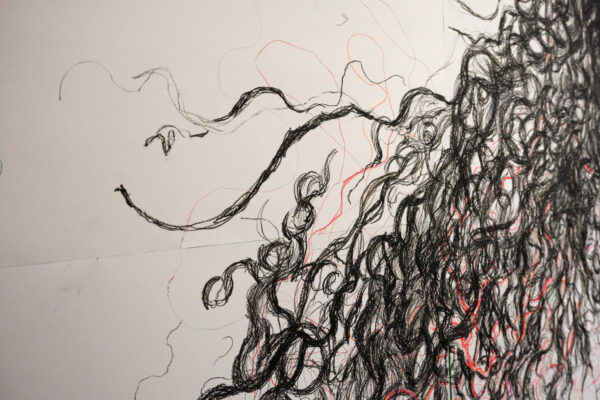
An interdisciplinary artist working with drawing, ceramics, and installation, Sharon Norwood develops a practice that interrogates systems of beauty, race, and power, attending to the symbolic charge of forms and gestures.
During the Open Studio, she presented numerous drawings structured around a recurring motif, curly Black hair, considered as a sign of presence, style, and the affirmation of identity. In the context of the Château, this work took on a particular resonance: occupying a place historically associated with luxury, prestige, and structures of power also meant questioning the narratives that have shaped it, in spaces where, historically, Black people were assigned to subordinate positions, marginalized, or excluded.
Through this symbolic gesture, the artist shifts the gaze, transforming the site into a space of visibility, reappropriation, and critical re-reading.
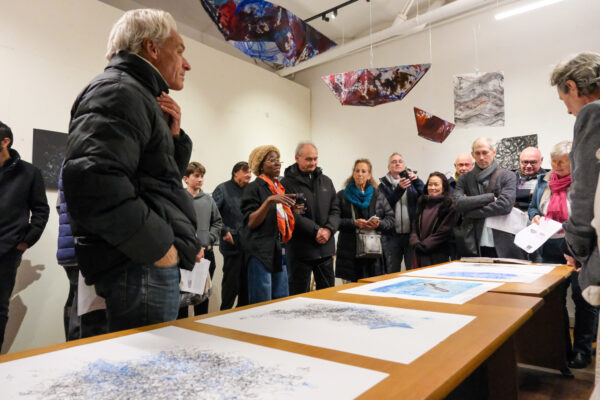 Sharon Norwood's studio | Photo credit: Laurent Barnavon
Jordan Kawchuk: Writing about Addiction
A writer of creative nonfiction, journalist, and producer, Jordan Kawchuk writes vulnerable, sometimes humor-tinged, stories about addiction treatment centers and his own recovery.
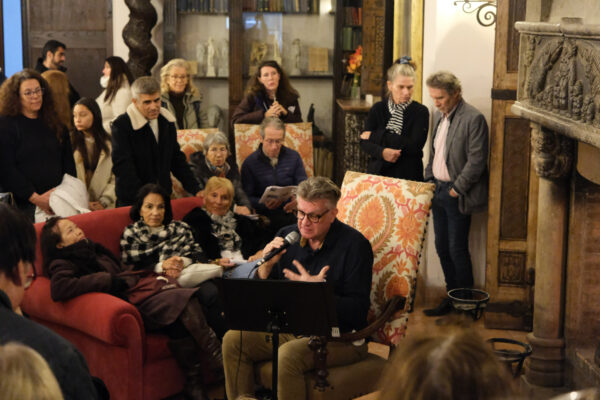
In Marie’s Salon, he delivered a deeply moving reading of a text written at La Napoule, evoking relapse, the weight of alcoholism, and the difficulty of “coming back up to the surface.” The collective listening, dense and silent, recalled the power of storytelling as an act of lucidity and, perhaps, a threshold toward healing.
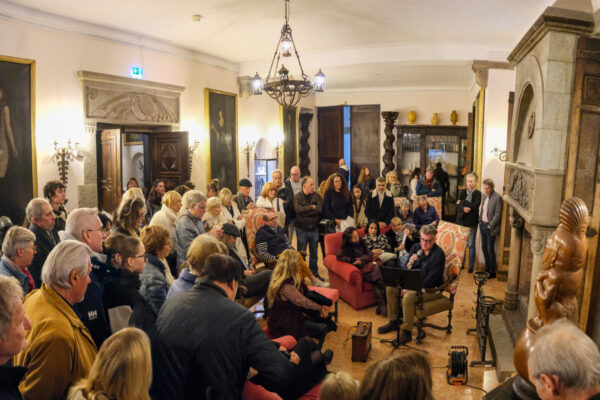 Jordan Kawchuk's reading | Photo credit: Laurent Barnavon
Jamiyla Lowe: Book, Place, and the Making of Narrative
An illustrator and screen printer, Jamiyla Lowe explores zones of friction between fantasy and reality, precarity and desire.
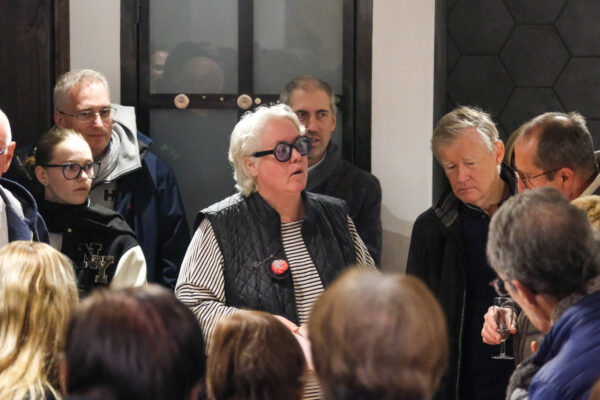
She presented a book project set in a dilapidated hotel, populated by battered figures, a microcosm in which architecture becomes metaphor. Speaking on the steps of the entrance hall, she emphasized how the Château, with its rooms and atmospheres, had fed the very structure of her book. She then invited the public into her studio to share sketches and process.
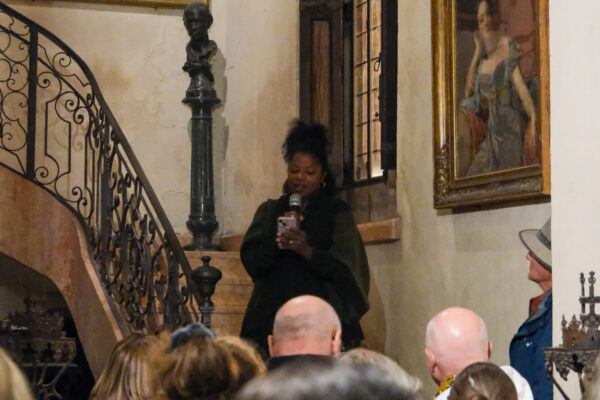 Jamiyla Lowe's introduction speech | Photo credit: Laurent Barnavon
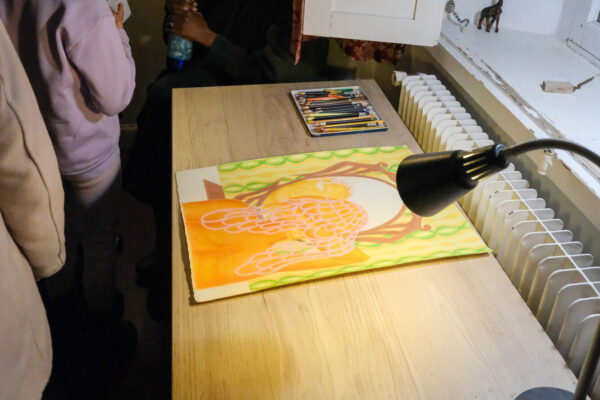
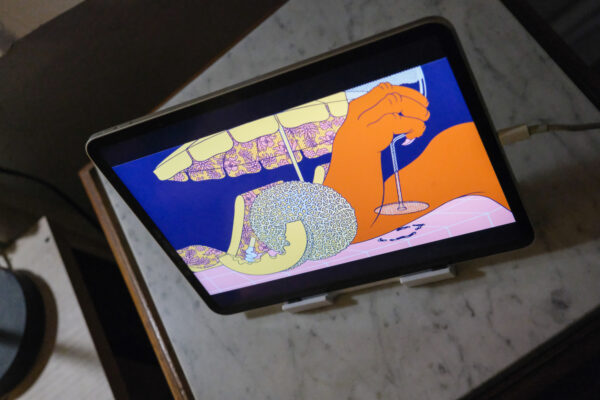
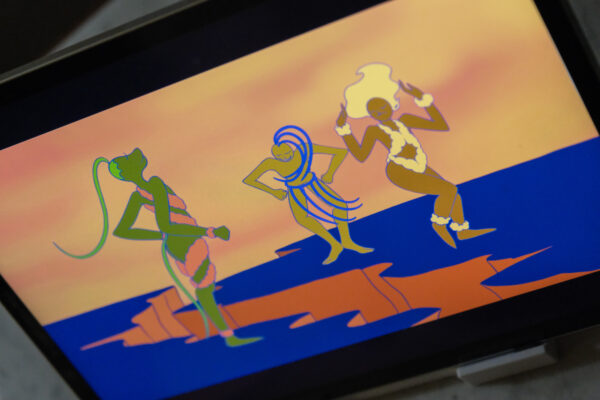
Chloë Charce: Ornament, Architecture, and Collective Memory
A multidisciplinary artist, Chloë Charce explores disappearance, temporality, and memory through sculpture, photography, video, and installation, working with light and matter.
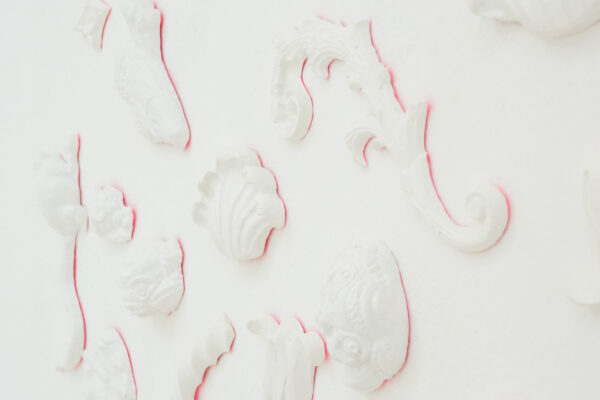
During the residency, she developed Une vie de château, a repertoire of ornaments inspired by the Château’s eclectic architecture, its gardens, and nearby façades.
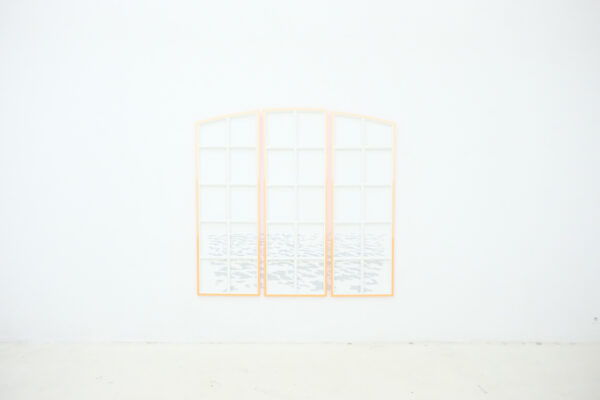
During the Open Studio, she presented collected elements that she then transformed (building-related fragments, painted window frames, imprints and casts): a way of bringing heritage into dialogue with a contemporary sculptural language, while making visible the role of Southern light as an agent of composition.
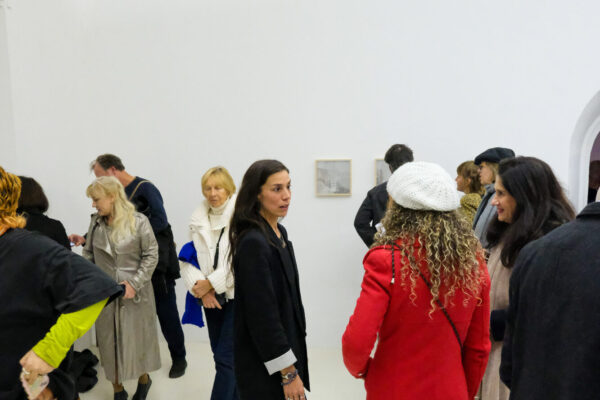 Chloë Charce's studio | Photo credit: Laurent Barnavon
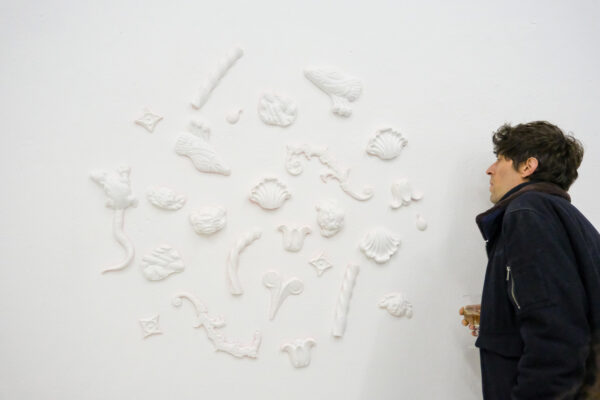
Craig Stuart Love: Painting, Text, and Traces of Place
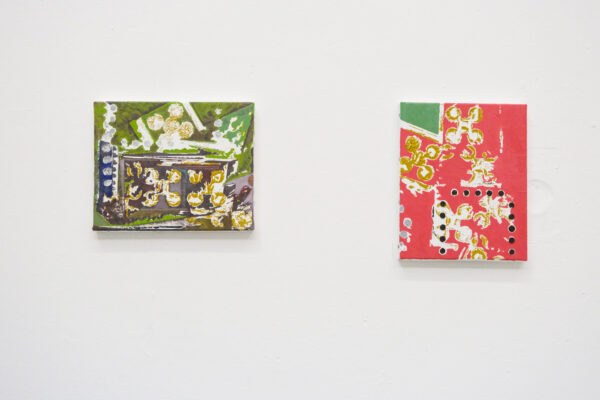
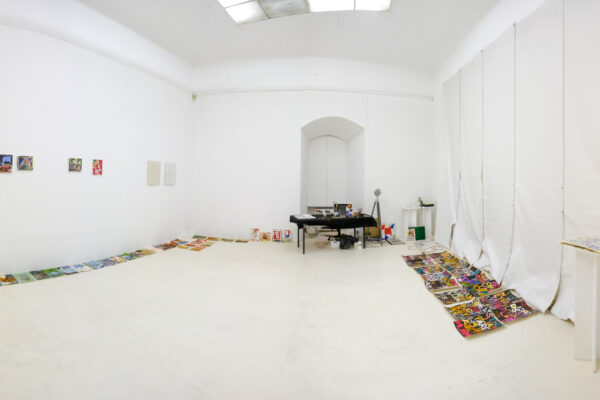
A painter and visual artist, Craig Stuart Love develops a practice in which painting and text closely converse. His works function as sensitive detours, exploring shifts between observation, interpretation, and abstraction, and how language, written or painted, remains always approximate and unstable.
During the residency, he drew on rubbing techniques to capture the Château’s surfaces and integrate them into his paintings, inscribing the site into the creative process itself. His work is grounded in variation and return, each piece acting like an open impression, in continual transformation.
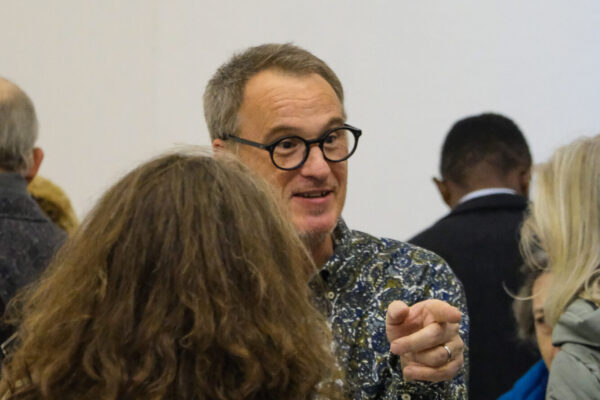 Craig Stuart Love's studio | Photo credit: Laurent Barnavon
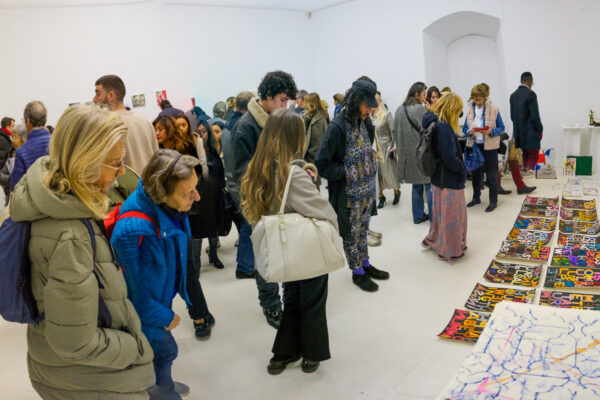
Jay Mosher: Light, Perception, and Spatial Disorientation
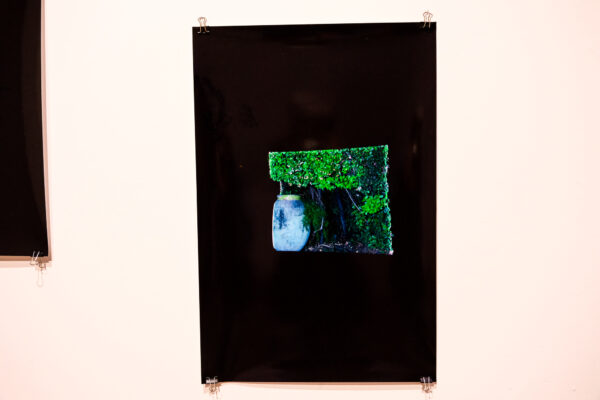
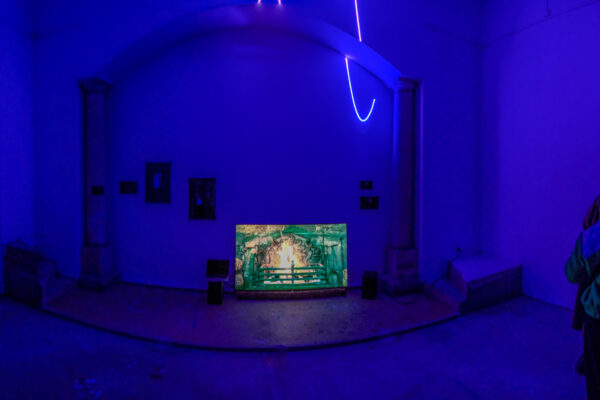
A visual artist whose practice combines installation, image, and light-based devices, Jay Mosher developed at La Napoule a video-and-light installation reimagining the Château as a surreal architecture of texture and light. During the Open Studio, he screened a film built from photographs taken in areas and lighting that are difficult to identify, creating a feeling of strangeness and a displacement of reality. The soundtrack, composed and produced by musician and sound artist Jairus Sharif, accompanied the film and helped shape the experience.
The experience continued with a light intervention on one of the Château’s towers, where a laser beam revealed the variations of light and texture in the space.
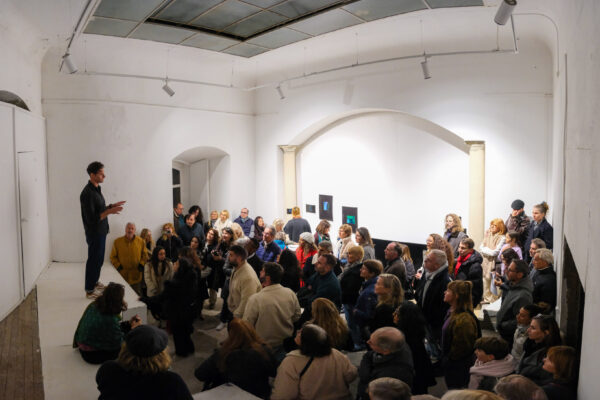 Jay Mosher's studio | Photo credit: Laurent Barnavon
Jairus Sharif: Improvisation, Listening, and Resonances of Place
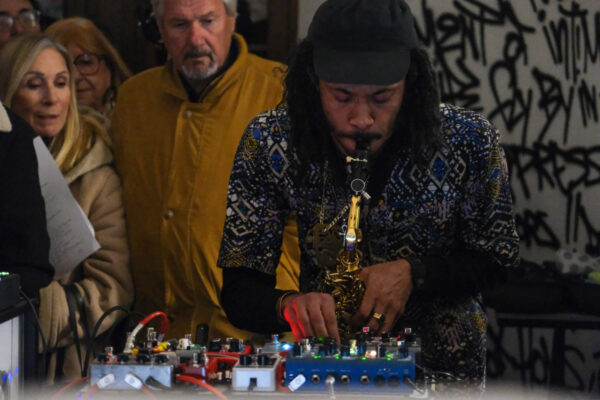
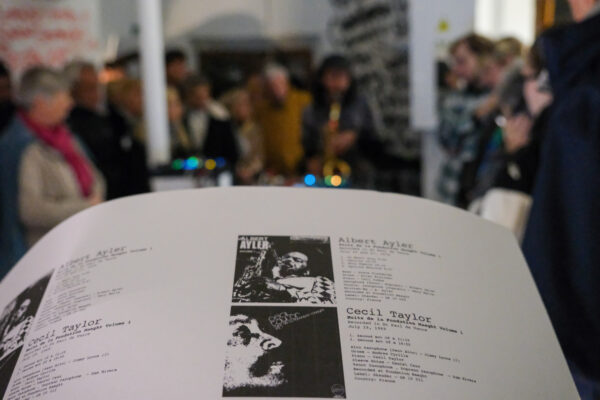
A musician and sound artist, Jairus Sharif develops a practice in which sound is approached as sculptural matter, oscillating between abstraction and meditative attention. He conceives the studio as an instrument in its own right, working with an evolving set of electronics, traditional instruments, and handmade tools, bringing into dialogue free improvisation, musical traditions, hip-hop, and the spiritual dimension of listening.
During the Open Studio, he presented his studio and performed live a piece composed for Jay Mosher’s film. The traces left on the walls by artist Ietef “DJ Cavem” Vita, graffiti and poems from the previous residency, became an important point of resonance with his practice, feeding a reflection on the site’s memory and the continuity of creative gestures.
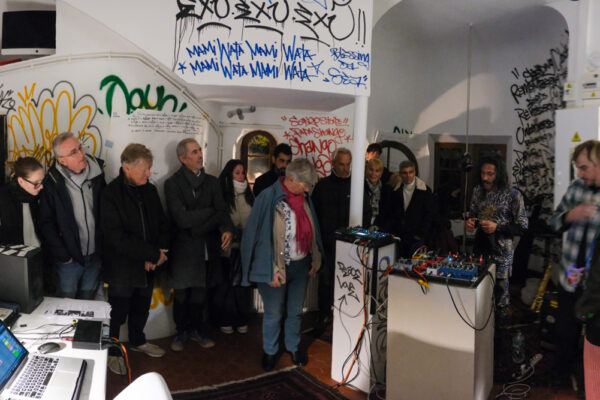 Jairus Sharif's studio | Photo credit: Laurent Barnavon
Jacinthe Loranger: Gentle Satire, AI, and Dystopian Illuminations
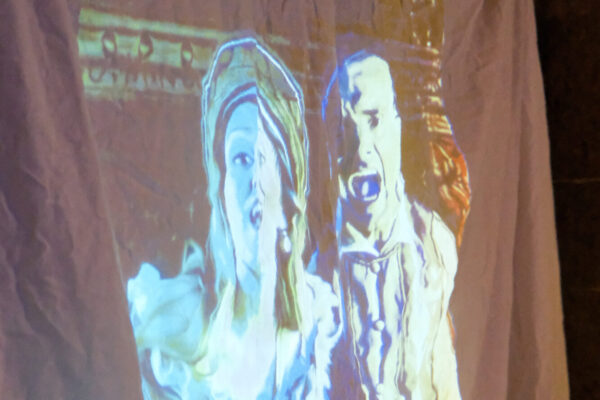
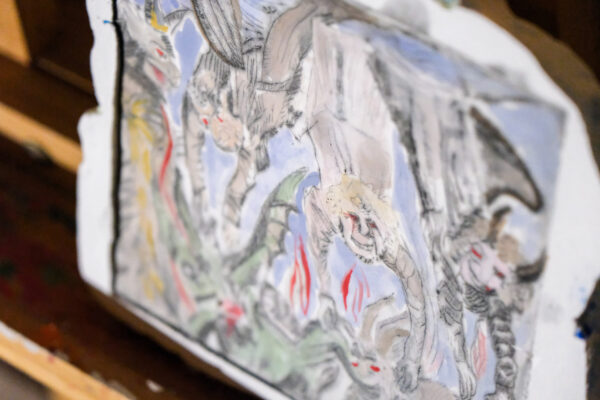
A multidisciplinary artist, Jacinthe Loranger approaches conspiratorial imaginaries, ideological drift, and the gray areas between belief, well-being, and manipulation with humor and social critique. At La Napoule, she developed a body of work inspired by medieval illuminations, the history of Henry and Marie Clews, and AI-generated images. Through drawing, ceramics, and video, she unfolds a kind of satirical and absurd dystopia about our contemporary relationship to truth.
During the evening, she presented experiments combining images of the Château, algorithmic transformations, and détournements: a theater of the absurd in which heritage iconography becomes a surface of political friction.
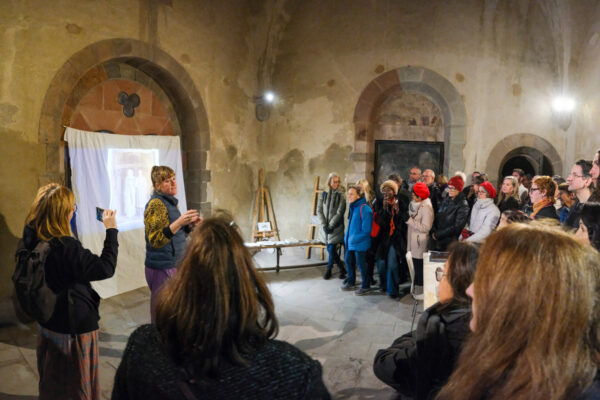 Jacinthe Loranger's studio | Photo credit: Laurent Barnavon
Frédérique Marseille: Tattooing, Writing, and the Economy of the Real
A writer and visual artist, Frédérique Marseille explores feminism, motherhood, the body, urban life, and remote territories, at the intersection of literature and visual arts.
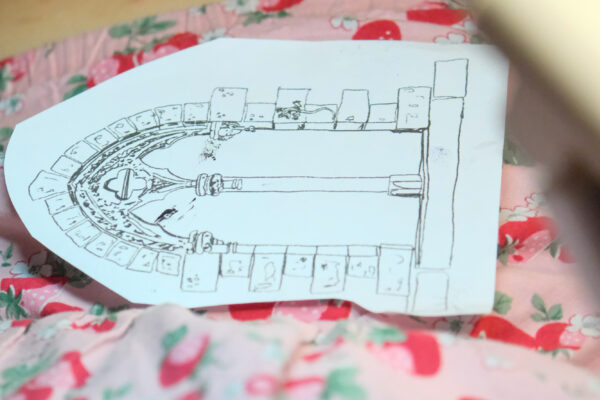
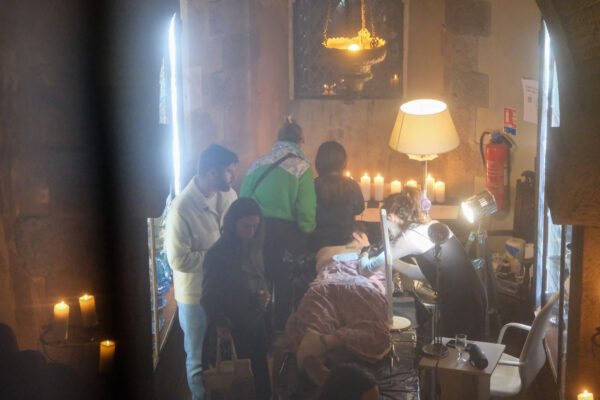
During the Open Studio, she chose to foreground her work as a tattoo artist, setting up an ephemeral studio and tattooing Haley Alakan White in the Gothic dining room. A performative, unapologetic gesture, inscribing the Château onto Alakan White’s skin before her return North. Her writing practice, meanwhile, unfolded more discreetly through printed text excerpts left available to visitors.
Through this shift, the artist opened a direct conversation about the economic realities of making: one is rarely “just” an artist, and the work that concretely makes an artistic practice possible deserves to be brought into the light as well.
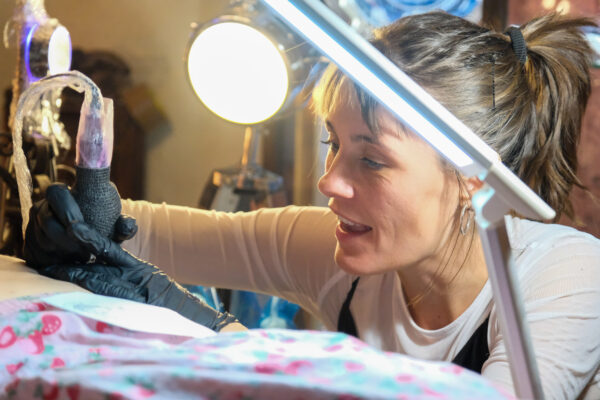 Frédérique Marseille tattooing Alakan White | Photo credit: Laurent Barnavon
![[Icon]](https://www.lnaf.org/wp-content/uploads/2021/04/icon-footer-panel@2x.png)
10 replies on “Canadian Residency – Fall 2025”
vardenafil tadalafil difference
vardenafil tadalafil difference
stendra generico
stendra generico
missed dose metronidazole gel
missed dose metronidazole gel
sildenafil tablet 50 mg uses in tamil
sildenafil tablet 50 mg uses in tamil
tadalafil online cheap
tadalafil online cheap
toradol moa
toradol moa
ivermectin pharmacokinetic characteristics
ivermectin pharmacokinetic characteristics
sildenafil economic factors
sildenafil economic factors
insurance policy
insurance policy
pneumonia cough
pneumonia cough